
A complete guide to packing for your trip abroad! This article compiles a list of carry-on and checked baggage lists and restrictions, explains how to pack for different seasons, summarizes packing tips, answers common questions for first-time packers, and finally shares the most recommended way to travel in the US with luggage: renting a car and driving yourself.
Table of contents
I. How to pack for traveling abroad? A complete packing checklist to avoid chaos.
Checklist for Traveling Abroad 1. Carry-on/Personal Baggage Checklist and Restrictions
Checklist for Traveling Abroad 2. Baggage Checklist and Restrictions
II. Summer vs. Winter: What to Pack? Sharing Travel Checklists for Different Climates
(a) Essential checklist for summer travel abroad: Pack light, breathable, and sun-protective luggage.
(II) Essential checklist for winter travel abroad: Pay attention to keeping warm while saving luggage space
III. Tips for packing luggage for overseas trips, and a guide to matching suitcase sizes with the number of travel days.
(a) 5-step packing process to keep your luggage organized!
(ii) Luggage size and packing strategies for different travel durations
IV. Answers to 5 common questions for first-time travelers preparing an overseas travel checklist
Q1: What are the size restrictions for carry-on/hand luggage?
Q2: Do I need to bring a transformer or an adapter when traveling abroad?
Q3: Can I take medicines out of the country? Do I need to declare them?
Q4: What items are included in "liquid" in luggage?
Q5: Are there any baggage restrictions for carrying "alcoholic liquids" abroad?
I. How to pack for traveling abroad? A complete packing checklist to avoid chaos.
When preparing for an overseas trip, the worst thing is arriving at the airport only to find you've forgotten your documents, or awkwardly opening your suitcase in front of customs. We've compiled a complete packing list for you, from essential carry-on documents to items that must be checked in or carried on due to flight safety regulations, allowing you to embark on a graceful and relaxed overseas journey.
Checklist for Going Abroad 1. Hand/Carry-on Baggage Checklist and Restrictions
| Essential items to carry | |
| Certificates | • passport • ID card • Visa documents • International driving permit/translated driver's license (if you need to rent a car and drive yourself) • Booking information / Boarding pass • Travel Insuranceprove 💡 Tips. In addition to paper copies, identification documents can also be photographed and saved to your phone or cloud for backup, just in case. |
| Property | • Foreign currency cash • Taiwan Dollar Cash • Credit cards/Debit cards/ATM cards 💡 Tips. It is recommended to keep your passport, wallet, and credit cards separately in different places in your carry-on luggage to avoid loss or theft and for greater security. |
| 3C products | • SIM card/eSIM installation instructions/roaming activation card • Mobile phone/tablet/laptop • camera Game consoles • Bluetooth earphones / Bluetooth earphone charging case • power bank • WiFi Switch • Rechargeable handheld fan 💡 Tips. Since different countries/airlines may have different regulations, it is recommended that electronic devices using lithium batteries be carried on board as a safer option. |
| drug | • Essential personal medications (for chronic illnesses, allergies, asthma, etc.) • Diagnosis/Prescription 💡 Tips. It is advisable to carry important medications with you at all times to avoid loss in checked baggage. Prescription medications may not be readily available abroad, leading to medication interruptions and health risks. |
| other | • House key • Neck pillow • Eye mask • Earplugs • Warm coat |
✈️ Due to flight safety requirements, the Civil Aviation Administration of China has regulations regarding carry-on/hand baggage restrictions.
1. Portable power bank
Because lithium batteries are at risk of spontaneous combustion under high voltage or impact, if they catch fire in the cargo hold, the crew will not be able to detect and extinguish the fire immediately. Therefore, power banks can only be carried on board and are prohibited from being checked in. Furthermore, the power bank must be clearly marked on its exterior, including mAh (milliampere-hour) and V (voltage) in order to calculate Wh (watt-hour).
- The calculation formula is: Wh = (mAh ÷ 1,000) × V
For example, a 20,000mAh, 5V power bank is equivalent to 100Wh.
According to civil aviation safety regulations:
- Portable power supplies with a rated energy of less than 100Wh do not need to be reported.
- Portable power banks with a rated energy of 100-160Wh can only be carried on board with the approval of the airline, and each person is limited to a maximum of 2.
If the power bank's label is unclear, making it impossible for security personnel to calculate the parameters, the power bank can be refused boarding.
2. Liquid, gel, and spray products
- Single item limitIn carry-on luggage, the capacity of a single liquid bottle must not exceed 100mL.
- Total quantity limitAll liquids in carry-on baggage must not exceed 1,000 mL in total.
In addition to the capacity restrictions, all liquids in carry-on luggage must be placed in a 20 × 20cm transparent sealed plastic bag, including lotion, toothpaste, toner, saline solution, hair wax, etc.
3. Cutting tools
Metal sharp objects, including scissors (blade length of 6cm or more), bottle openers (sharp tip length of 5cm or more), Swiss Army knives, utility knives, fruit knives, metal needles, folding razors, and disposable razors (with exposed and non-removable blades), must be checked in and cannot be carried on board.
4. Lighter
If you need to bring a lighter abroad, you can only carry it with you, and each person is limited to one lighter. The lighter cannot be a windproof lighter.
5. Pepper spray
Many women may carry pepper spray for self-defense, but pepper spray is actually classified as a "weapon" and cannot pass through security checks when leaving Taiwan. It cannot be carried in baggage or hand luggage, so please be careful.
6. Baby food
If you are traveling with an infant or toddler and need to bring infant formula or food with you, you should declare it first and obtain confirmation and approval from security personnel before you can bring it on board.
✈️ Additional regulations for different airlines or countries
Airlines and local civil aviation authorities may have different "extra restrictions." Below are some key points that are commonly encountered. It is recommended that you learn more about your destination and flight before you depart.
1. Portable power bank
Some countries or airlines may have stricter restrictions on carrying portable power banks, such as: the USB port and power switch must be sealed with insulating tape, they must be placed in a transparent ziplock bag, and they cannot be used on airplanes.
2. Umbrellas
Due to limited cargo space on airplanes, inability to accommodate umbrellas in X-ray machines, and concerns about their offensive nature, some airlines or airports have regulations regarding the size of umbrellas allowed on board. Common size guidelines are as follows:
- Umbrellas with a folded length of less than 60cm can be carried on board.
- Straight umbrellas or folding umbrellas longer than 60cm can only be checked in.
3. Selfie stick, camera tripod
Selfie sticks, camera tripods, and other long, stick-shaped objects may be restricted at airports in various countries due to their potential for being offensive. In Taiwan, for example, selfie sticks or camera tripods with a tube diameter exceeding 1cm or a folded length exceeding 60cm are not allowed on board and must be checked in as baggage.
4. Powdered items
If you are planning to travel to the United States and are carrying powdery substances of 350mL or more (excluding milk powder, medicine, and ashes), you must check them in as baggage. You cannot carry them on board. Airlines will conduct random checks at the boarding gate, so please pay extra attention to this rule when packing your luggage to avoid affecting your boarding and entry rights.
Checklist for Traveling Abroad 2. Baggage Checklist and Restrictions
| Checked baggage list | |
| Daily necessities | • Toothbrush, toothpaste, shampoo, conditioner, body wash, facial cleanser • Cosmetics, skincare products, sunscreen • Hand sanitizer, alcohol spray, alcohol wipes • Towels, bath towels, shower caps • Facial tissues, wet wipes • Razor, nail clippers, comb, mirror, hair accessories • Contact lenses, commonly used medications 💡 Tips. If you are bringing personal care small appliances such as electric toothbrushes and electric shavers, since the built-in lithium battery capacity is not large, as long as you take precautions to prevent them from starting and avoid exposing the blades (or remove the blades), you can either check them in or carry them on board. |
| Clothing | • Underwear Outerwear • pajamas • Spare shoes • slippers • sock |
| 3C products | • Charging cable • Voltage adapter • Luggage scale 💡 Tips. Many people carry baggage scales to avoid exceeding baggage weight limits. If the baggage scale is a rechargeable model with a built-in lithium battery, it needs to be carried on board. Conversely, if the battery is removable, the scale can be checked in, and only the battery needs to be carried on board. |
🧳 Baggage carrying restrictions
1. Fresh food
Many people worry about not being used to local food when traveling abroad, so they bring some fresh food with them. However, when bringing such products, it's important to pay special attention to the entry regulations of each country to avoid inadvertently violating relevant laws.
For example, Taiwan prohibits the import of uninspected raw meat and fresh fruits and vegetables, including raw milk, eggs, seafood, apples, guavas, and mangosteens. Restrictions on meat are particularly strict, including processed meat products such as meat-filled mooncakes and instant noodles.
In the United States, for example, all fruits, vegetables, seeds, and meat products (including dried meat, meat floss, canned meat, instant noodles with meat, bread/sandwiches with meat, pet food, etc.) are prohibited from entering the country. For certain food items, such as seafood, UHT canned goods, coffee, tea, and seasonings, it is recommended to declare them honestly upon entry to avoid fines.
2. Liquid
You can carry more liquids in your checked baggage than in your carry-on baggage, including lotions, gels, and creams, but there are still regulations that each bottle must not exceed 500mL and the total volume must not exceed 2,000mL.
3. Electronic cigarettes
The regulations for bringing electronic cigarettes/heated cigarette devices, which have become increasingly popular in recent years, vary greatly from country to country. In the United States, for example, electronic cigarettes can only be brought in for personal use, and if the device model is not certified by the FDA, it will be subject to stricter entry inspection.
4. Lighter
Lighters are not allowed in checked baggage. Lighters may only be carried by hand, with a limit of one lighter per person. Only regular lighters are permitted; windproof lighters are not allowed.
5. Equipment containing lithium batteries
As mentioned earlier in the carry-on baggage section, all "devices containing lithium batteries" are prohibited from being checked in, such as power banks, spare batteries, heated hand warmers, rechargeable vacuum compressors, and rechargeable luggage scales. Only a few devices with very small, negligible lithium battery capacity, such as electric toothbrushes and electric shavers, are allowed to be checked in.
In addition, Bluetooth headset charging cases, which are commonly used by modern people, fall under the individual regulations of each airline. It is recommended to check with the airline beforehand to see if they can be checked in or if they must be carried on board.
6. Other items
In addition to the items mentioned above, various countries also have specific regulations for certain items. For example, the United States prohibits the carrying of explosives, dangerous chemicals, guns, ammunition, controlled weapons, knives, prohibited drugs, narcotics, and counterfeit goods. It is recommended to thoroughly understand the entry restrictions of the destination country before departure and double-check whether your luggage complies with the regulations.
In addition, people traveling abroad should also pay attention to Taiwan's entry regulations in addition to their destination, to avoid bringing back illegal souvenirs or gifts, which could result in confiscation and fines, making the whole trip end in regret.
II. How to pack for summer vs. winter? (Based on different climates)List of people going abroadshare (joys, benefits, privileges etc) with others
When traveling abroad, it's not enough to just pack everything; you also need to pack for the right season. The packing and clothing strategies completely change depending on the season. We recommend packing with the goal of providing breathable and sun-protective clothing for summer, and warm yet space-efficient clothing for winter. Below, we've compiled packing suggestions for different climates to help you make smarter and better use of your suitcase space.
(I) SummerEssential checklist for traveling abroadLuggage should be lightweight, breathable, and sun-protective.
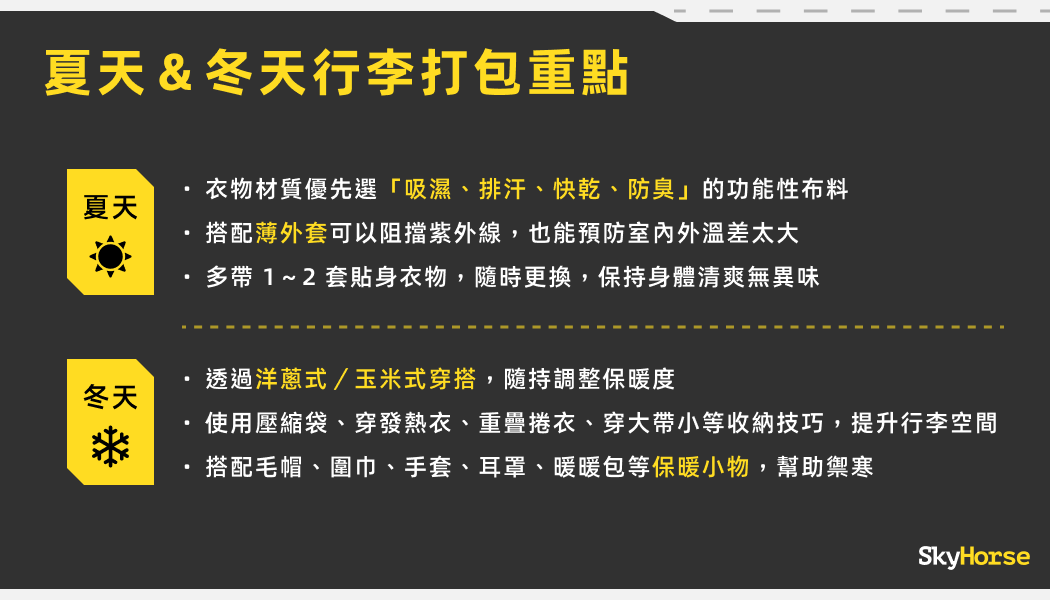
1. Logic of Summer Clothing Selection
- Clothing materialWhile cotton clothing is comfortable, it is difficult to dry after sweating and is prone to odor. Therefore, it is recommended to choose functional fabrics that are moisture-wicking, quick-drying, and odor-resistant.
- Light jacketIt is recommended to bring a light jacket when traveling in summer. This can not only help block strong ultraviolet rays, but also prevent you from catching a cold when entering air-conditioned airports, shopping malls or restaurants.
- Increase replacement frequencyIf you are someone who sweats easily, it is recommended to bring 1-2 extra sets of underwear than the number of days you are traveling, so you can change them as needed and keep your body fresh and odor-free.
2. Recommended practical items for summer travel
- Sun hat, sunglassesIt's a great partner for sun protection, helping to protect your skin and eyes from excessive UV damage.
- ziplock bags, waterproof storage bagsIt can hold wet clothes from playing in water or sweating, isolating them from odors and moisture, and preventing them from soiling other clean luggage.
- Handheld fanWhen traveling in the summer, you may encounter situations where you need to queue to enter popular attractions. In such cases, having a handheld fan can help cool you down and reduce the risk of heatstroke. However, it is important to remind you again that you should pay attention to the battery type when bringing a handheld fan abroad. If it is a rechargeable fan with a built-in lithium battery, it must be carried on board.
(II) Essential checklist for winter travel abroad: Pay attention to keeping warm while saving luggage space
1. Two essential winter dressing formulas
- Onion-style outfitsThis is a winter dressing method that many people have probably heard of. It involves layering clothes in multiple ways, such as an inner layer for moisture wicking, a middle layer for warmth, and an outer layer for wind protection. It's like the structure of an onion, where you can add or remove layers to adjust the warmth based on temperature changes or outdoor activities.
- Corn-style outfitThe corn-style outfit is a layering method that emphasizes a thin inner layer and a thick outer layer. The inner layer consists of lightweight thermal or functional clothing, while the outer layer is a sufficiently warm coat or jacket. This style is suitable for countries with large temperature differences between indoors and outdoors, where you only need to take off a coat when you go indoors.
2. Storage techniques to save luggage space
- Vacuum compression bagsVacuum compression can save 30-50 % of space for bulky items such as down jackets and sweaters, improving the efficiency of luggage utilization.
- The principle of wearing big clothes and carrying small clothesHeavy clothing such as snow boots, long boots, and down coats are recommended to be worn on board. Packing lightweight sneakers or flat shoes in your suitcase will effectively reduce the burden of checked baggage.
- Make good use of heated clothingOne high-quality thermal underwear can replace two to three heavy sweaters, making it a great helper for reducing luggage weight and saving luggage space.
- Overlapping clothesLaying clothes flat and stacking them up before rolling them up will save more space than folding each garment individually.
3. Recommended practical items for winter travel
- beanie, scarf, gloves, earmuffsKeeping the extremities warm can help the body stay warmer.
- Hand warmerYou can bring a small number of disposable hand warmers to use immediately upon landing to help keep warm, and then buy more later to save luggage space. Also, please note that rechargeable or heated hand warmers contain lithium batteries and therefore cannot be checked in; they must be carried on board.
Three,Packing luggage for going abroadTips, luggage size comparison with travel days
When traveling abroad, the biggest fear is not having enough space for your luggage or not having room for souvenirs on the way back. Next, we will share the steps to pack your luggage neatly and teach you how to choose the right suitcase according to the number of days of your trip, so that you don't have to worry about insufficient luggage space and can fully enjoy your trip.
(a) 5-step packing process to keep your luggage organized!
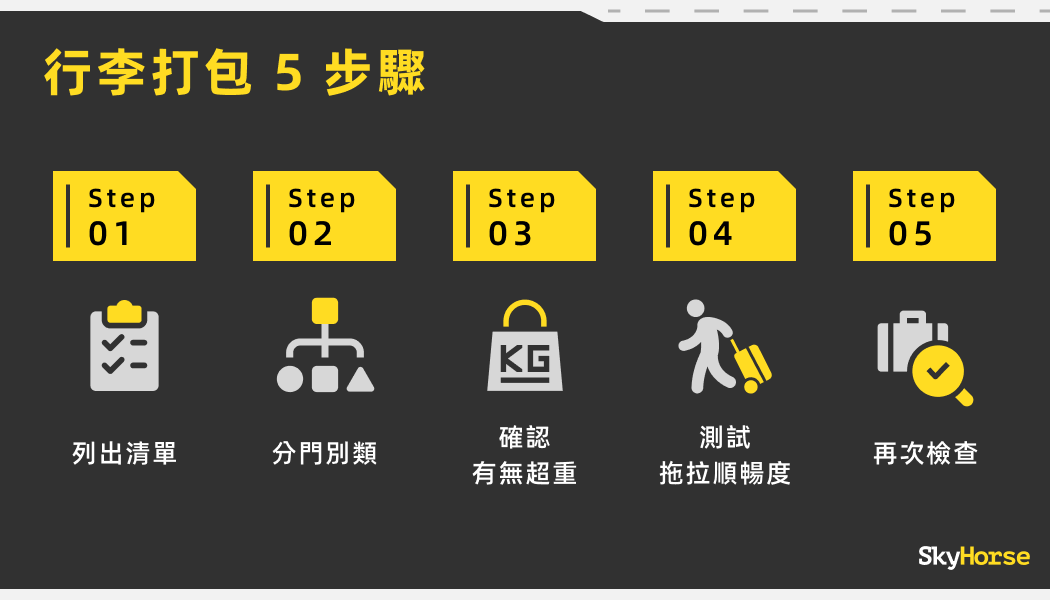
- ListFirst, make a list of the items you need to bring. You can also refer to the table provided above to help you pack your luggage and avoid packing and thinking at the same time, which may lead to carrying duplicates or forgetting key items.
- Categorization:Organizing items by category (such as underwear bags, medicine bags, cosmetic bags, etc.) can prevent you from rummaging through drawers and make it easy and accurate to find what you need.
- Check if you are overweightAfter you have finished packing your luggage, remember to weigh it to make sure that it does not exceed the baggage weight limit set by the airline.
- Test drag smoothnessBesides weight, another very important thing is to test whether the items are placed evenly so as not to affect the smoothness of pulling the suitcase.
- Check againFinally, the day before departure, check the checklist again to make sure nothing is missing, then lock your suitcase, tie the straps, and happily set off.
(ii) Luggage size and packing strategies for different travel durations
When traveling abroad, many people struggle with the question, "How big of a suitcase should I bring?" Below, we've compiled suitcase sizes and packing suggestions for different travel durations, whether it's a short trip of 3-5 days or a long trip of 7-10 days.
| short term | Mid-term | long | |
| Days | 3-4 days | 5-7 days | 7 days or more |
| luggage size | 20-inch carry-on bag | 24-26 inch suitcases | 28-29 inch suitcase |
| PackStrategy | To create a "mix-and-match" look, choose two versatile pants/skirts and pair them with three to four tops, creating different styles through repeated layering. For skincare products, use sample packs or small-capacity travel-size bottles, and discard them after use. | Bring enough underwear for the exact number of days, and prepare an extra set of spare clothes. If your destination or hotel has self-service laundry facilities, you can even bring only 4 days' worth of clothes to reduce weight. | It is recommended to focus on having enough clothes for "one week". If the trip is longer than 7 days, you can arrange for a hotel to provide laundry services so that you can have enough space to store your souvenirs on the way back. |
IV. Preparation for BeginnersList of overseas travel destinationsAnswering 5 Frequently Asked Questions
Feeling overwhelmed about packing before traveling abroad? Don't worry, we've compiled and answered 5 frequently asked questions from beginners, including luggage size restrictions, voltage issues, and the carrying of medications and liquids, to help clear up your confusion!
Q1: What are the size restrictions for carry-on/hand luggage?
Generally, carry-on baggage is limited to a total length, width, and height of no more than 115cm (approximately a 20-inch suitcase). However, each airline may have specific size regulations, such as the longest side not exceeding 54cm. It is recommended to check the airline's website before departure.
In addition to carry-on luggage, you can usually bring one more carry-on backpack or laptop bag, but if it is too large, it may still be required to be included in the total weight calculation, so please pay special attention.
Q2: Do I need to bring a transformer or an adapter when traveling abroad?
Before deciding whether to bring a transformer or an adapter, it's important to understand the differences between the two:
- adapter: Change the shape of the socket so that the plug can be adapted to the socket (for example, Taiwan mostly uses flat sockets, while European countries use cylindrical sockets).
- transformerChange the voltage output of the socket to match the safe voltage range that the device can use (e.g., convert 220V to 110V).
If the country you are going to has the same or similar voltage but a different type of socket, you will need to prepare an "adapter" rather than a "transformer"; conversely, if the sockets are the same but the voltage is different, you will need to bring a "transformer".
Voltage and socket types vary from country to country. Below is a summary of common national voltage and socket types:
- United States, Canada120V, Type A/B
- Japan100V, Type A
- South Korea220V, Type C/F
- U.K.230V, Type G
When packing your luggage, be sure not to confuse the two, otherwise it may cause equipment damage and affect your travel experience.
📖 Further Reading:US Voltage Guide: Can Electric Toothbrushes, 3C Chargers, Hair Dryers, and Curling Irons Bring from Taiwan Be Used? Find the Answer in One Article!
Q3: Can I take medicines out of the country? Do I need to declare them?
Yes, but each country has different restrictions and definitions of drug ingredients. Some traditional Chinese medicines may use ingredients from endangered plants and animals, or some Western medicine ingredients may be considered illegal drugs or narcotics abroad. It is recommended to check carefully before departure, declare truthfully in advance, and prepare complete packaging, English diagnosis certificate or prescription to avoid penalties.
Q4: What items are included in "liquid" in luggage?
In aviation security, the definition of "liquids" is much broader than we imagine. In addition to water and beverages, any item that is "gelatinous," "paste-like," or "contains juice" is subject to liquid restrictions.
If you plan to carry your luggage on board, the following items must not exceed 100mL each. If they exceed this capacity, please be sure to put them in your checked baggage:
- Easily overlooked souvenirsJams, honey, puddings, jellies, miso, chili sauce, kimchi, canned goods, yogurt, cream, cheese spreads, etc.
- Personal care itemsProducts include: toothpaste, facial cleanser, shampoo, conditioner, shower gel, hand cream, foundation, concealer, lip gloss, mascara, perfume, sunscreen spray, dry shampoo, etc.
Q5: Are there any baggage restrictions for carrying "alcoholic liquids" abroad?
Alcoholic liquids are divided into "drinking" and "medical" types, and the regulations for carrying them differ slightly:
Alcoholic beverages
- Alcohol concentration < 24%No quantity limit.
- Alcohol concentration 24-70 %Each person is limited to 5L of baggage, and the baggage must be in retail packaging.
- Alcohol concentration > 70%Checking in or carrying on is strictly prohibited.
Medical alcohol
- portableEach bottle should not exceed 100mL and must be placed in a transparent resealable bag.
- Check-inEach bottle must not exceed 500mL, and the total weight of all bottles, including perfumes, hairsprays, and other spray bottles, must not exceed 2kg.
5. What's the most convenient way to pack luggage when traveling in the US? We recommend renting a car!
The United States is a vast country, and many people travel there for extended periods, often involving frequent intercity travel. Public transportation in the United States is also not as convenient as in Taiwan.
If you plan to travel by subway or bus with luggage, you'll not only face the challenge of not having elevators, but also need to constantly monitor your luggage. Therefore, renting a car is the best option to make traveling in the United States much easier.
Why is it necessary to drive yourself when traveling in the United States?
- Hands-free luggageNo need to drag heavy suitcases between airports, hotels, and train stations; just put your luggage in the back of the vehicle and you can go directly to the attractions or accommodations.
- High degree of spatial freedomIf your luggage is large or you've bought too many souvenirs during your trip, the interior space of your car is your best mobile storage, so you don't have to worry about not being able to carry them by hand.
- No travel restrictionsMany stunning national parks or hidden gems in the United States (such as Antelope Canyon and Yosemite) offer greater flexibility for travel when visited by car.
Recommended US car rental companies::SkyHorse Car Rental
With so many car rental brands available, which company should you choose? We recommend the highly reputable "SkyHorse Car Rental," making your trip to the US safer and more convenient. SkyHorse Car Rental offers the following advantages:
- Full Chinese serviceWhether it's questions during booking or unexpected situations encountered during the trip, you can communicate in your familiar language at any time, eliminating language barriers.
- InsuranceWhen you rent a car, we offer three different levels of insurance options, which you can purchase according to your individual needs, making your driving more worry-free.
- Convenient pick-up and drop-off pointsWe offer flexible pick-up and drop-off locations based on your travel itinerary, including major airports, downtown areas, and surrounding cities in Los Angeles, San Francisco, San Diego, and Las Vegas.
- A variety of models are availableSkyHorse Car Rental offers a variety of car models, including sedans, SUVs, and minivans, allowing you to choose the most suitable vehicle based on the number of passengers and the size of your luggage.
Don't want to lug your luggage around and switch modes of transportation? Click the button below to book your exclusive American ride now.
📖 Further Reading:
- What are the must-buy items in the US? Recommended shopping list and complete guide to outlet transportation.
- How to apply for a US visa (ESTA)? Complete answers to required documents, steps, fees, and frequently asked questions.
- Antelope Canyon Travel Guide: 3 Main Sightseeing Areas, Transportation, Nearby Attractions and Accommodation All in One Go

