
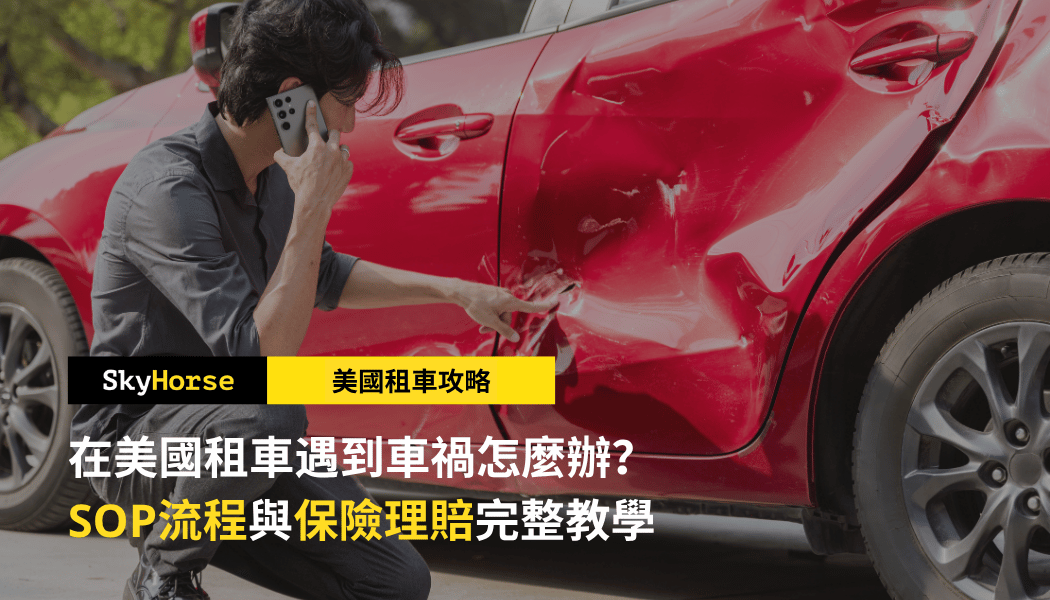
With over 6 million traffic accidents in the United States each year, unfamiliar road conditions and different driving habits certainly increase the risks for tourists. However, as long as you know the correct SOP (Standard Operating Procedure), a car accident doesn't necessarily ruin your trip—in most cases, following the steps will allow you to leave the rest to your insurance and rental company.
This article will take you through the entire process, from "the moment of the accident" to "how to follow up on the claim after returning to Taiwan".
Highlight the finishing touches:
Step 1: SOP at the Accident Site
Step 1| After confirming it is safe, pull over to the side of the road.
First, assess your own and your passengers' condition. If the vehicle is still movable, move it to the shoulder or a safe location and turn on your hazard lights. If the vehicle is immobile, remain inside and fasten your seatbelts while awaiting assistance. If you have a warning triangle or reflective vest in your vehicle, place it behind the vehicle to alert oncoming traffic.
⚠️ If there are signs of fire or leakage at the scene, immediately leave the vehicle and move to a safe distance. Do not attempt to retrieve your luggage.
Step 2 | Call 911 to report the incident (this is essential!).
Regardless of the size of the collision, it is always recommended to call 911 to report it. Once the police arrive at the scene, they will prepare a Police Report, which is the core document for subsequent insurance claims. Without a Police Report, insurance companies or car rental companies may encounter difficulties processing claims, and this could even affect the amount of compensation.
In some states (such as Florida), the law mandates calling the police if an accident results in personal injury or property damage exceeding $500. Even for minor collisions, calling the police is the best way to protect yourself.
✅ US emergency number: 911 (can be dialed from any mobile phone, no local phone card required)
Step 3| Do these things before the police arrive.
① Take as many photos and videos as possible.
- The location and extent of damage to both vehicles (photographed from every angle).
- Both vehicle license plate numbers
- A complete view of the accident scene (intersection, traffic signs, road conditions, weather).
- The other driver's license and insurance card (take photos for archiving).
- Any visible injury
② Exchange information with the other party
- Name, Phone Number, Email
- driver's license number
- License plate number and vehicle registration information
- Insurance company name and policy number.
③ Question the witnesses
If any bystanders are willing to stay, remember to ask for their names and contact information. Eyewitness accounts are sometimes crucial in determining liability.
④ Do not say "sorry" or admit your mistake.
Even if you think it might be your fault, don't say "I'm sorry" or "It was my fault" at the scene. These words can be legally interpreted as admitting responsibility, which could affect subsequent insurance claims. Just describe the facts; leave the determination of liability to the police and the insurance company.
Step 4 | Contact the car rental company
Once the police arrive, contact your rental car company's emergency services number as soon as possible. This number is usually printed on the rental agreement, in a folder in the glove compartment of the car, or on the rental company's app.
Common emergency numbers:
- Hertz:1-800-654-5060
- Avis:1-800-352-7900
- Enterprise:1-800-307-6666
- Sky Horse:You can contact us via LINE or emergency contact number +1-949-439-7432 for immediate assistance.
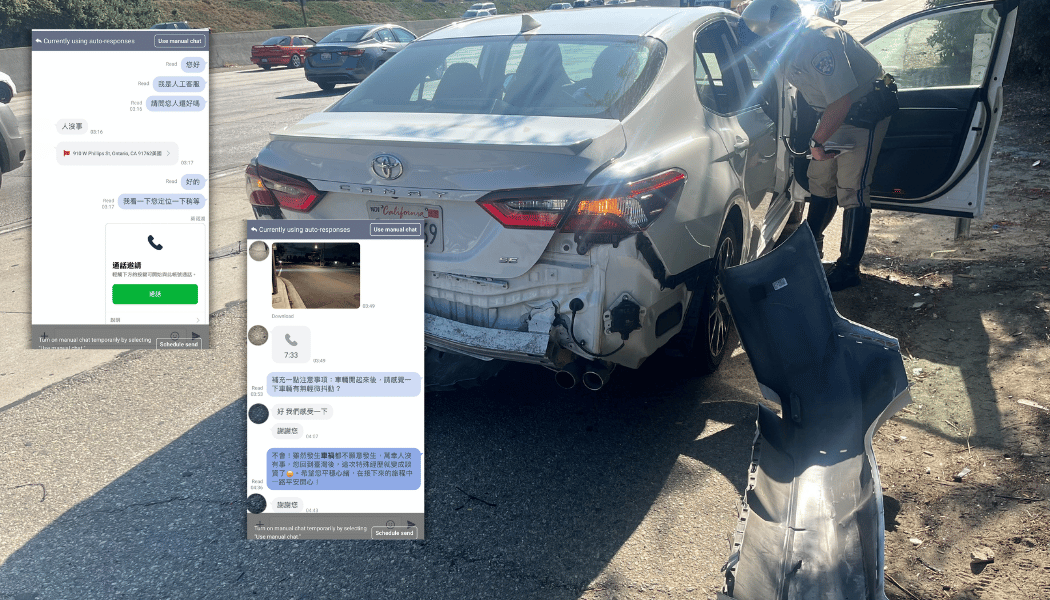
⚠️ Failure to notify the rental company immediately may result in the insurance being voided, as most rental agreements explicitly state this.
Step 5 | Cooperate with the police in handling the case and obtain the report number.
After the police arrive, truthfully describe the accident. Remember to confirm with the police afterwards.
- Police Report NumberThe full report can be obtained using this number.
- When can I expect to receive the report (usually 1–2 weeks)?
- How to obtain it (download online or collect in person)
Step 6| Seek medical attention as needed
Even if you don't feel injured at the time, it's recommended to get a medical evaluation as soon as possible. Soft tissue injuries to the neck or back (such as whiplash) may not show symptoms for 24–48 hours. Medical records are not only for your health protection but also important documents for future insurance claims.
On-site SOP Quick Reference
| step | action | Key Points | Notice |
|---|---|---|---|
| Step 1 | Once it's safe to proceed, pull over and turn on your hazard lights. | Move to a safe location | Get away from flames immediately. |
| Step 2 | Call 911 to report the crime | Obtaining a Police Report is essential for claims processing. | In the United States, people only call 911 to report emergencies. |
| Step 3 | Taking photos, exchanging information, and asking witnesses | The more images, the better | They don't say sorry, they don't admit their mistakes. |
| Step 4 | Contact the car rental company and fill out an accident report form. | The sooner the better | Contracts typically require immediate notice. |
| Step 5 | Cooperate with the police and obtain the report number. | Police report can be picked up in approximately 1–2 weeks. | Write down the number |
| Step 6 | Seek medical attention as needed | Soft tissue injuries may be delayed. | Keep all receipts |
Step Two: Understand Your Insurance Structure
After an accident, the most important question is: who pays? The answer depends on what insurance you purchased before departure. For Taiwanese travelers renting cars in the United States, insurance typically comes from three sources.
Car rental company insurance
| Insurance Name | abbreviation | Coverage |
|---|---|---|
| Vehicle damage/collision insurance | CDW/LDW | Collision damage and theft of the rental car itself (most important) |
| Third-party liability insurance | LIS/SLI | Personal injury and property damage caused to third parties (most important) |
| Tire and window protection | TWP | Tires and windshields are damaged (some businesses may need to purchase replacements). |
| Personal Accident Insurance | PAI | Medical expenses for the driver and passengers |
| Personal Effects Insurance | PEC | Loss of personal belongings inside the vehicle |
| Roadside assistance | Roadside Assistance | Emergency assistance for tire blowouts, running out of gas, lost keys, etc. |
The two most important ones:CDW/LDW (insures your rental car) + LIS (insures the other party's damage). Without these two, you will be fully responsible for all costs incurred in the event of an accident.
✅Sky Horse's premium insurance plan C includes CDW/LDW (coverage of US$50,000 with zero deductible, providing full coverage for most vehicle models) + LIS (third-party liability insurance with coverage of $30,000 per person for bodily injury, up to $60,000, and $15,000 for property damage); it also covers tire and windshield (TWP) coverage, which most companies exclude from their contracts.
Credit card car rental insurance
Some credit cards (especially high-fee travel cards) offer rental car insurance, which usually covers CDW/LDW (pay special attention to whether the coverage is sufficient and the exclusions), but almost never includes third-party liability (LIS).
Two types:
- Primary Coverage:After an accident, the credit card company will directly compensate the credit card holder; cards with higher annual fees usually do this.
- Secondary Coverage:Other primary insurance policies must be in place first; these policies will only be activated if the coverage is insufficient.
Activating credit card insurance typically requires: paying the full rental fee with the credit card + refusing the rental company's CDW/LDW; both are mandatory.
Travel accident insurance (purchased in Taiwan before departure)
Travel accident insurance primarily covers personal accident and medical expenses, corresponding to the functions of PAI (Pay-As-You-Go). Medical costs in the United States are high, so it is crucial to confirm the adequacy of your travel accident insurance's medical coverage before departure.
In what situations will insurance companies not provide compensation?
- The driver is not on the contract list:Only registered drivers are covered. If an accident occurs while a friend is temporarily driving for a short distance, the coverage may be invalid.
- Breach of car rental agreement terms:Such as DUI (Driving Under the Influence) or driving on roads restricted by the contract (sand, unpaved roads).
- Damage beyond the scope of the claim:Most chain car rentals' CDW (Card-Warranty) does not include tires, chassis, or windows; you need to confirm the policy details (Sky Horse's premium insurance plans all include these).
- Failure to notify the car rental company in a timely manner:Failure to contact the car rental company immediately after an accident may affect the claims process.
Step 3: What is the process for claims afterward?
| Condition | Claims process |
|---|---|
| There are CDW/LDW (car rental companies). | On-site report completion → Car rental company processing → Potential out-of-pocket charges; Large operators entrust Fleet Response / Viking to contact. How to handle SkyHorse? No upfront payment is required for coverage up to the insured amount, and Sky Horse handles insurance claims directly, eliminating the need to contact the insurance company directly. |
| Credit Card Insurance | Notify the credit card company → Submit a Police Report + contract + bill + photos + repair estimate → Await review |
| Third-party platform insurance | Pay for car repairs yourself → Keep the receipts → Apply for a refund from the insurance company (this process may take a long time). |
| No CDW/LDW | Repair costs + Loss of Use fee + administrative fees, all to be paid out of pocket, potentially exceeding ten thousand US dollars. |
Credit card claim procedure
- Notify the credit card company immediately after the incident (applications typically need to be submitted within 30–60 days).
- Documents to submit: Police Report, car rental agreement, credit card statement, accident photos, repair estimate.
- The credit card company will determine the compensation amount after review.
Note: Credit card insurance claims are usually slower than those from car rental companies, and some companies require you to pay for repairs first before you can apply for a refund.
Handling methods for several special cases
The other party has no insurance (or has absconded).
- Call the police immediately.Ensure the Police Report records either "Hit and Run" or "Uninsured Driver".
- Try to remember the other vehicle's license plate number (even just part of the number is helpful).
- Notify car rental companies and credit card companies
- If you have purchased CDW/LDW, this situation is usually covered by the warranty.
Parking lot scratches (no information about the other party)
- Take photos of the damage
- If the damage is minor and there is CDW/LDW (zero deductible), notify the rental company and have it dealt with upon return of the car.
- If the damage is severe, you can choose to call the police and leave a record.
Tire blowout or mechanical failure
- Roadside assistance is available.Call the car rental company's emergency number directly; someone will answer 24 hours a day.
- No roadside assistance:You can contact AAA (if you are a member) or call 511 (road information hotline in some states).
- Tire costs:If you purchase a TWP (Take-on-Demand) device, it's usually covered; otherwise, you'll have to pay for it yourself.
Frequently Asked Questions (FAQ)
Q: After a car accident, can I still drive the rented car?
A: It depends on the extent of the damage; you need to confirm with the rental company. If the vehicle is still safe to drive, you can continue using it; if there are safety concerns, contact the rental company to arrange a replacement vehicle.
Q: The other party said they want to settle privately without calling the police. Is that okay?
A: I strongly advise against it. Settling privately bypasses police reporting and insurance procedures. If the other party later claims you caused the accident and fled the scene, or if there are further losses, you have no protection. Rental car contracts usually also require you to report the incident to the police and notify them.
Q: I'm fine with only minor scratches, do I absolutely have to call the police?
A: Legally, it depends on the state regulations (most states only require a police report if the property damage exceeds a certain amount). If the accident involves a third party, it is strongly recommended to report it to the police. A police report is the most important document for insurance claims; without it, there may be many problems later on.
Q: What should I do if I get injured and medical expenses in the United States are very high?
A: That's the purpose of travel accident insurance and PAI (Payable Insurance). Emergency room costs in the US can easily reach thousands to tens of thousands of US dollars. Receive treatment first, keep all receipts and medical records, and then file a claim with the insurance company after returning to Taiwan. It's very important to confirm that your travel accident insurance medical coverage is sufficient before departure.
Q: I've already returned to Taiwan, and the car rental company sent me a bill. Is this normal?
A: That's normal. Large companies like Avis and Hertz use Fleet Response or Viking Client Services to handle subsequent claims. Receiving letters or emails from these companies is a legitimate procedure; simply provide the insurance information as instructed. If you have any questions, contact the rental company first to confirm.
Q: I bought credit card insurance. How long after returning the car do I need to file a claim?
A: It varies from company to company, but most require applications to be submitted within 30–60 days. Initiate the application process immediately upon receiving any fee invoice; do not delay.
Do these things before setting off, and post-accident handling will be twice as easy.
When picking up the car
- Take videos of the vehicle's perimeter (including the undercarriage edges) to confirm that any existing damage is recorded in the contract.
- Confirm that all drivers listed on the contract are registered (no compensation will be paid if an accident occurs while a driver is not registered).
- Write down or screenshot the car rental company's emergency contact number.
✅Sky HorsePhotos taken upon vehicle handover, along with the dashboard mileage and fuel level, will be simultaneously uploaded to your online rental agreement, which you can view and download at any time.
Insurance Confirmation Checklist
- CDW/LDW (Complete Damage Coverage): Required.
- LIS/SLI (Third-Party Liability Insurance): Required, with a recommended coverage amount of at least $30,000 per person.
- Roadside Assistance: Highly recommended, especially if your trip includes suburban or national park areas.
- TWP (Tire and Window Coverage): Consider purchasing this additional coverage if your policy does not include it.
- PAI (Personal Accident Insurance): If the travel accident insurance coverage is sufficient, it is not necessary to purchase it again.
Car always have
- Car rental agreement (including emergency contact number)
- Passport copy
- Travel accident insurance policy information
- Emergency Contact List
summary
If you get into a car accident while renting a car in the US, the process is actually quite clear when broken down:
- Ensure safety → Pull over to the side of the road and turn on your hazard lights
- Call 911 → Obtain Police Report
- Collect evidence → Take photos, exchange information, and don't admit mistakes.
- Contact the car rental company → Fill out the accident report form as soon as possible.
- Confirm insurance structure → Decide which claims channel to use
- Seek medical attention as needed → Keep all medical documents
The easiest way is to confirm both CDW/LDW and LIS insurance before departure, and then let the insurance company handle the matter after an accident.
Planning a road trip in the United States requires having insurance in hand before you can truly hit the road with peace of mind.
SkyHorse offers a complete insurance plan including CDW/LDW + LIS in the US. The advanced plan has no deductible and covers tire and window protection, so you don't have to worry about insurance before picking up the car.

